Monday, November 16, 2009

Panasonic Lumix DMC-GH1


Pay Less! $1459.64
Not long after announcing its first Micro Four Thirds camera in September of 2008, Panasonic started giving hints that a next-generation of the camera might include what seemed like a glaring omission from the Lumix G1: Video. Within two weeks, Panasonic showed a prototype camera at the Photokina tradeshow that promised a capable high-definition video mode with a stereo microphone. Equally interesting was a prototype 14-140mm lens shown on the unnamed G-series body mockup, which featured the letters "HD."
 
Basic Specifications
Resolution: 12.10 Megapixels
Kit Lens: 10.00x zoom
14-140mm
(28-280mm eq.)
Viewfinder: EVF / LCD
LCD Size: 3.0 inch
ISO: 100-3200
Shutter: 60-1/4000
Max Aperture: 4.0
Mem Type: SDHC / SD
Battery: Custom LiIon
Dimensions: 4.9 x 3.5 x 1.8 in.
(124 x 90 x 45 mm)
Weight: 32.8 oz
(930 g)
MSRP: $1,500
Availability: 06/2009


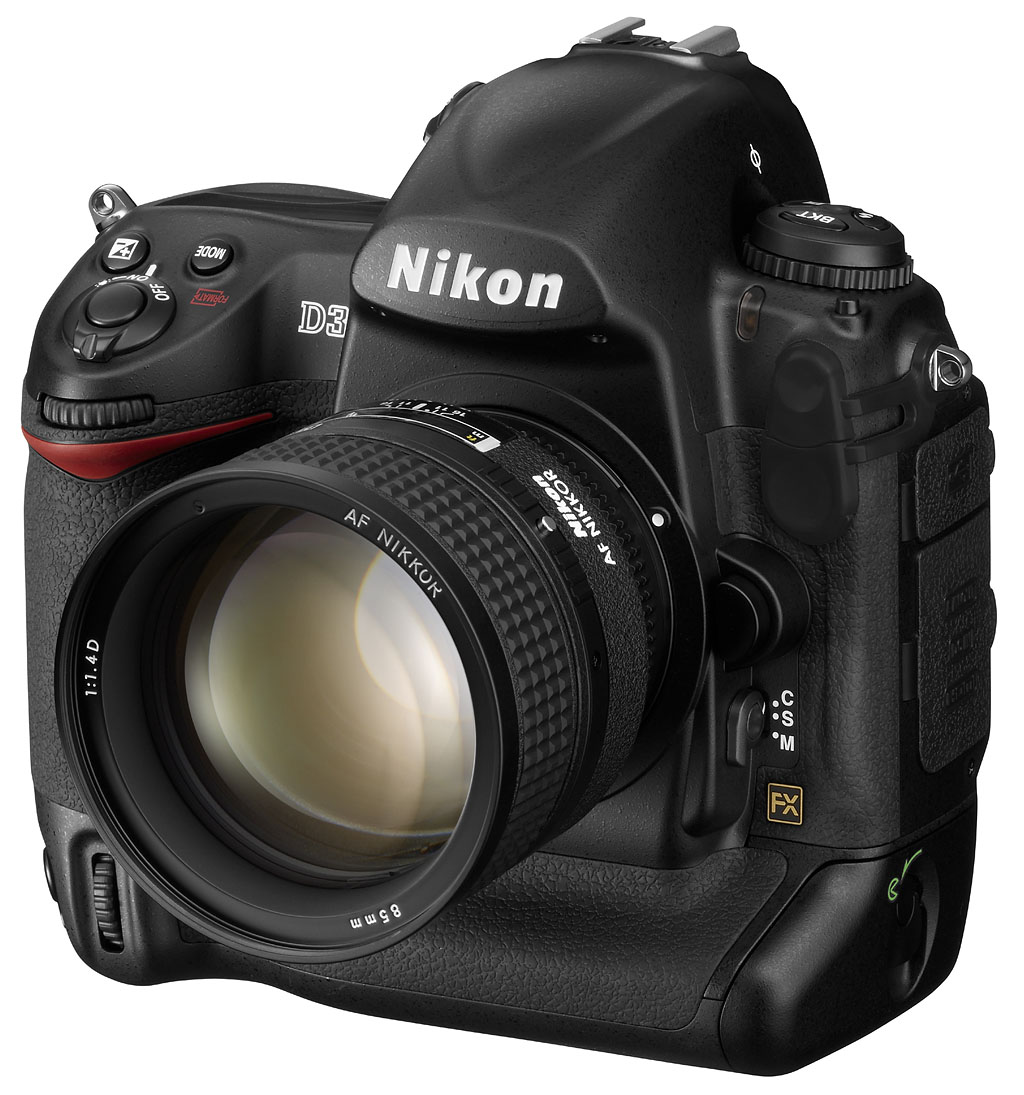
Nikon D3


Pay Less! $4673.50

The big news was that Canon finally had a rival in the full-35mm space. It had been a long time coming. As they did with the D2x, Nikon struck a very fine balance with the D3. It's not 16 or 21.1 megapixels like the Canon 1Ds line, it's 12.1. And it's not a full 10 frames per second, like the 1D Mark III, it's 9; but you can get to 11 frames per second if you don't need full resolution and focusing tracking. It's an interesting and effective strategy. While they've surrounded Canon's models at the low end, they're still wisely splitting the difference at the pro end, and the resulting cameras are more versatile than the competition.
But resolution and frame rate aren't the only important aspects to this new professional digital SLR camera. The Nikon D3 has 14-bit A/D conversion, just like the D300 that was introduced at the same time, plus the option of stepping back into 12-bit A/D conversion if you desire. The Nikon D3's new Scene Recognition System merges data from the AF system with data from the 1,005-point metering system for greater accuracy and better tracking. A new 51-point AF system includes 15 cross-type sensors and a wide range of modes to take best advantage of them. And the 920,000 pixel, 3-inch LCD rivals the Nikon D3's own optical viewfinder for clarity; both offer 100% viewfinder coverage.
In-camera Lateral Chromatic Aberration Correction, optic-by-optic autofocus fine-tuning, a wide ISO range of 200 to 6,400, plus extension to Lo-1 (100) and Hi-2 (25,600!), really round out the package.
As if to underscore how Nikon has split the difference between the Canon 1Ds and 1D Mark III offerings, the price of the Nikon D3 digital SLR is $4,999.95.


Nikon Coolpix S630


Pay Less! $246.98
Glossy, sleek, compact and definitely good-looking, the Nikon Coolpix S630 comes in an array of stylish colors that go outside the norm. Its super shiny front body panel looks like candy, and its gently-curved shaping is very comfortable for back pants pockets. The Coolpix S630 features a 7x, glass zoom lens and a 12-megapixel CCD, backed up by Nikon's latest EXPEED image processor. The camera also employs a 4-way VR Image Stabilization system, which takes camera shake, subject movement, ISO and the trademark Best Shot Selector mode into consideration to produce sharper images. Also included are several automatic functions, such as smile, blink and face detection, which all work together to get better portraits, and a Scene mode Auto Selector that determines the best preset Scene mode to use for the subject at hand.
Basic Specifications
Resolution: 12.00 Megapixels
Lens: 7.02x zoom
(37-260mm eq.)
Viewfinder: LCD
LCD Size: 2.7 inch
ISO: 64-6400
Shutter: 4-1/4000
Max Aperture: 3.5
Mem Type: SDHC / SD
Battery: Custom LiIon
Dimensions: 3.8 x 2.3 x 1.0 in.
(97 x 58 x 26 mm)
Weight: 5.7 oz
(162 g)
MSRP: $280
Availability: 02/2009
Test Summary
(Mouse over items for explanations)
Power-on Time 2.8 sec
Shutter Lag,
Full Autofocus
0.415 - 0.616 sec
Shutter Lag,
Prefocused
0.008 sec
Shot to Shot time 2.16 sec
Battery Life
(CIPA standard)
220 shots

Canon Vixia HF S11


Price range:

 
Many companies turn out SD-based camcorders in compact designs, simply because the flash-based technologies allow for much smaller models than those based on tape, hard disks, and mini DVDs. While Canon continues to offer compact AVCHD models, the Vixia HF20 and HF200, the company's branching out with slightly more "pro" prosumer offerings in the Vixia HF S11, Vixia HF S10 and Vixia HF S100.
These three models, which record 1,920x1,080-pixel 60i resolution video, feature a larger, faster f1.8 10X HD lens and a relatively large, high-resolution 1/1.26-inch 8-megapixel CMOS sensor, along with higher-end capabilities, such as SMPTE color bars, the capability to manually boost gain up to 18dB, fixed 70 and 100 IRE zebra stripes, and a user-assignable button/control dial combo. They differ by internal memory--the HF S100 has none, while the HF S10 has 32GB and the HF S11 has 64GB--and the HF S11 adds Dynamic SuperRange OIS, designed to compensate better while walking and at wide angles, and Advanced Snapshot mode, which means you can pull four-second clips from videos in playback mode, as well as in capture mode. This review is based on my previous complete evaluation of the HF S10, with added detail based on testing of the new OIS system.

Kodak EasyShare Z950


BUY the Z950 Digital Camera
The Z950 is Kodak's attempt to tap into the market for compact ultrazoom cameras begun by Panasonic with its popular TZ camera line and lately joined by virtually all the major digital camera producers. While the Z950 may lack some of the polish of the more sophisticated (and expensive) compa
ct ultrazooms, it has a lot going for it, including a 10x optical zoom, a high-quality Schneider-Krueznach lens, HD video, an Intelligent Auto mode (which Kodak calls "Smart Capture") and manual exposure controls.


Nikon Coolpix S1000pj projector-cam


Man, the Nikon Coolpix S1000pj has gone from crazy rumor to seemingly-real to whoa-here's-the-press-release in record time -- the compact cam with the integrated projector was just officially announced, along with the three other cams we saw leaked earlier today. Leaked specs for the S1000pj were dead-on: a 12.1 megapixel sensor with ISO 6400 sensitivity mounted behind a 5x wide-angle zoom lens with five-way VR stabilization, and that LED-powered projector that'll put up a 40-inch image for slideshows complete with music, effects and transitions. We're a little less excited about the $430 list price this thing will carry when it hits in September, but on the whole it's a pretty terrific idea and we're completely intrigued -- looks like we'll be saving our pennies this month. Pictures of everything in the gallery, deets on the other cams and a video of the S1000pj after the break.
 

Sony Cyber-shot DSC-W190


Pay Less! $145.82


The Sony W190 is closely related to the W180 model, alongside which it was announced, the only real difference between the two being that the W180 has ever so slightly lower sensor resolution. The Sony W180 is based around a 1/2.3"-type Super HAD CCD image sensor with twelve megapixel resolution coupled to a Sony branded 3x optical zoom lens. The Sony W180 offers equivalent focal lengths which range from 35 to 105mm - a rather tight wide angle to a moderate telephoto. Maximum aperture varies from f/3.1 to f/5.6 across the zoom range. The W180 forgoes any optical viewfinder in favor of a 2.7" LCD display with 230,000 dot resolution.


Sunday, November 15, 2009

Canon EOS 7D

The Canon 7D is the digital SLR that many Canon fans have been waiting for, with a long list of long-absent features that the lineup has needed to take on cameras like the Nikon D300.

Not shying away from the megapixel race, the new Canon 7D has a brand new 18-megapixel APS-C sensor with a 1.6x crop factor. Each pixel is 4.3 microns in size, though Canon says that with their gapless microlenses, the new sensor gathers plenty of light.

The Canon 7D is designed for speed, with dual DIGIC 4 chips to speed processing of these large 14-bit files, as well as keep up with the shutter's 8-frame-per-second top speed. Even the sensor had to be tweaked to enable such speed, with an 8-channel readout to more quickly draw the image off the sensor.

The Canon 7D's buffer can handle 94 JPEGs at top speed, or 15 RAW images.

For its part, the Canon 7D's shutter mechanism is rated at 150,000 cycles, and is the same design used by the 1D-series of Canon digital SLRs.

EV compensation has been expanded to five stops in either direction, and the ISO ranges from 100 to 6,400, with an expanded setting up to 12,800. The Canon 7D also sports an HD movie mode that will capture full HD at 30p.

The built-in flash has a wider range to handle up to 15mm wide-angle lenses, like the new EF-S 15-85mm f/3.5-5.6 IS USM, and the flash can also serve as the remote commander for up to three groups of flashes, another first for Canon.

Other new features include an electronic level, a RAW button, and a new Multi-function button for quick, programmable access to various functions. And don't forget the new 19-point autofocus system, complete with a new LCD viewfinder display overlay, obviating the need for interchangeable screens.

The Canon 7D is expected to ship toward the end of September 2009, and retail body-only for $1,699. A kit with the 28-135mm f/3.5-5.6 IS lens will sell for $1,899.

Resolution:18.00 Megapixels
Kit Lens:n/a
Viewfinder:Optical / LCD
LCD Size:3.0 inch
ISO:100-12800
Shutter:30-1/8000
Max Aperture:n/a
Mem Type:CF1 / CF2
Battery:Custom LiIon
Dimensions:5.8 x 4.4 x 2.9 in.
(148 x 111 x 74 mm)
Weight:33.3 oz
(945 g)
MSRP:$1,699
Availability:09/2009

Canon PowerShot SX120 IS


Canon seems to have an "if it ain't broke" attitude when it comes to its PowerShot SX series. The SX120 IS is the latest version of the company's 10x pocket megazoom and is nearly identical to its predecessors, the SX110 IS and SX100 IS. The SX120 IS gets a resolution bump--it's now 10-megapixels--and uses Canon's Digic 4 image processor, which along with enhanced battery life adds advanced face and motion detection features and improved red-eye correction. It's not much of a step forward, just offering a little bit of new technology for the price of 2008's SX110 IS. You also get the same excellent photo quality, which is nice, but ever-so-slightly slower performance, which is less nice.